Make curiosity portable
You do not need bags of synthetic craft supplies or wet paints that spill on clothing. Open-air creative play thrives on small observant eyes, scrap paper, and what the meadow already provides.
The Art of Low-Impact Field Exploration
Outdoor creativity works best when it asks children to look more closely at the textures and sounds around them. When kids transition from racing around to quiet investigation, their sensory focus narrows. Having three or four self-directed observation prompts gives young minds a productive channel that requires zero adult policing.
Respect for the park habitat is essential: we collect fallen leaves, dropped pine needles, and dead twigs rather than snapping living shoots off branches. This basic habit instills conservation awareness early and naturally.
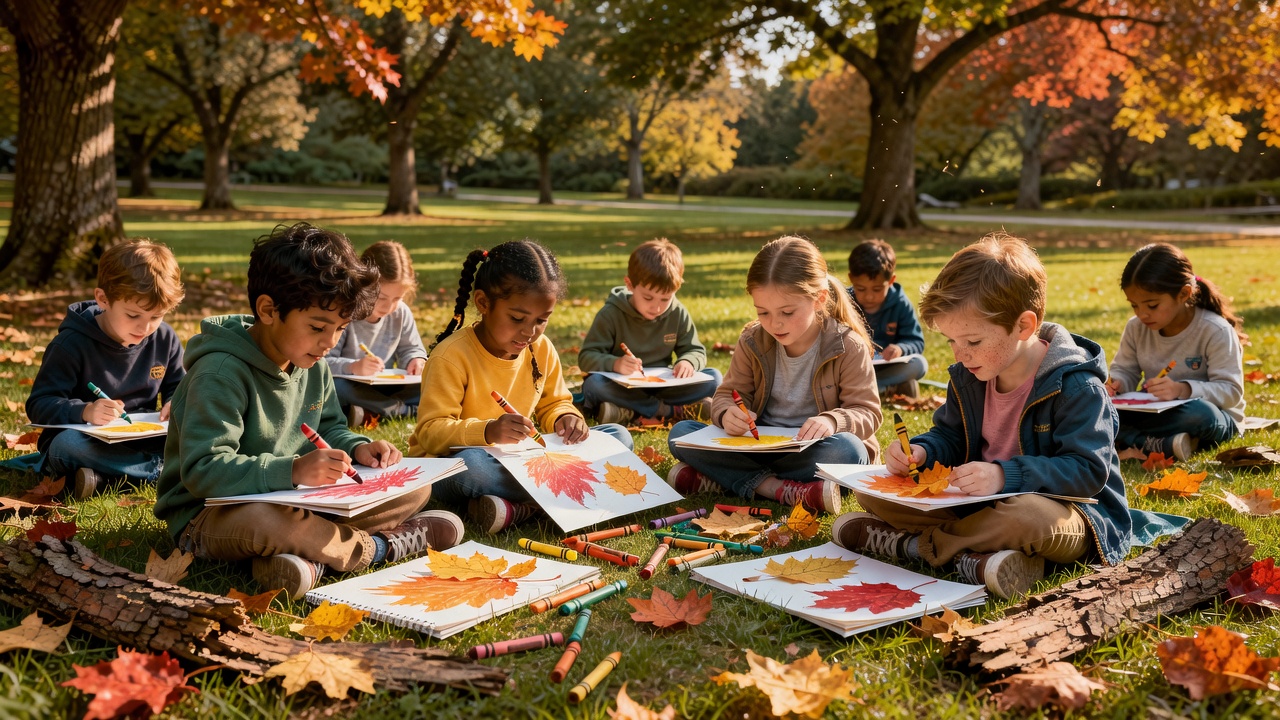
A firm clipboard and a handful of wax crayons convert park benches and logs into miniature botanical studios.
5 Simple Tactile Activities
1. Four-Minute Sound Mapping
Give each person an index card with an "X" drawn directly in the center to represent where they sit. Everyone closes their eyes in complete silence for four minutes. Whenever they hear a sound, they draw a simple mark relative to their position: a zigzag for a barking terrier to the north, wavy lines for the creek behind them, dot clusters for fluttering leaves overhead.
2. Heavy Wax Bark & Leaf Rubbings
Strip the paper sleeves off thick dark-red, black, and forest-green wax crayons. Place freshly fallen oak, sycamore, or beech leaves vein-side-up beneath cartridge paper. Rubbing the flat edge of the crayon sideways across the paper transfers the vascular skeleton of the leaf in sharp relief. Children can then test different tree bark textures around the glade.
3. The Matchbox Micro-Museum
Hand each child an empty small cardboard slide box (or small mint tin). Challenge: fill the container with ten completely different non-living natural specimens found within twenty paces. Items might include a feather barb, a tiny quartz pebble, an acorn cap, a dried snail shell fragment, and a lichen flake. Comparing their micro-collections back at the rug fosters lively storytelling.
4. Water Brush Botany Sketches
Instead of water cups that tip over on blanket fabric, use refillable barrel water brushes paired with a pocket 6-color watercolor tin. The brush feed delivers just enough dampness to paint small sketches of moss, daisies, or cloud patterns on heavyweight 300gsm postcard blanks. They dry in sixty seconds in the open breeze.
5. Clay Imprint medallions
Carry a single 250g block of self-hardening air-dry terracotta clay in an airtight zip pouch. Roll coin-sized balls between palms, flatten them on a smooth river stone, and press pine needles, acorn shells, or seed pods into the surface. Leave them in the sunshine on the blanket edge to cure while enjoying your afternoon tea.
How to Transition Between Vigorous Games & Quiet Craft
Children rarely jump instantly from full-tilt sprinting into delicate watercolor sketching. If you force an abrupt pause, you will meet resistance. The gentlest bridge is the "Specimen Scramble": announce that before anyone takes out a pencil, they have three minutes to find three fallen items of completely different colors.
This physical search serves as an energetic deceleration ramp. By the time they return to the blanket to inspect their treasures, breathing has leveled, heart rates have cooled, and their attention is primed for quiet, tactile creation.